Battery Thermal Management on Hybrid Excavators: Sizing Mistakes That Only Surface in Summer
Battery thermal management decides how reliably a hybrid excavator holds its duty cycle, how long the pack lasts, and what the machine costs to own. An on-road hybrid gets steady airflow at highway speed; an excavator sits in dust at walking pace and swings heavy, intermittent loads, so its cooling has to be engineered rather than assumed. Thermal sizing sets whether the pack can reject the heat from continuous digging, swing, and lift cycles without derating power or tripping a protection shutdown.
Undersized systems rarely fail in mild weather. Cool spring mornings and moderate fall afternoons hide marginal cooling capacity, and a machine can run for months looking healthy. The gap between heat generated and heat rejected only becomes visible once ambient temperatures pass 35°C (95°F) – then it shows up as power derating, faster cell degradation, and downtime during peak construction season.
This article covers how correct battery thermal management sizing is calculated, why hybrid excavator cooling margins so often come up short, and which sizing mistakes only appear once summer heat arrives.
Battery Thermal Management Fundamentals on Hybrid Excavators
A hybrid excavator battery rarely dies from one hot afternoon. It dies because heat keeps stacking up across a full shift while the cooling loop was sized for a mild spring day. Understanding how a battery thermal management system actually moves that heat is the first step toward building one that survives July.
Where the Heat Comes From
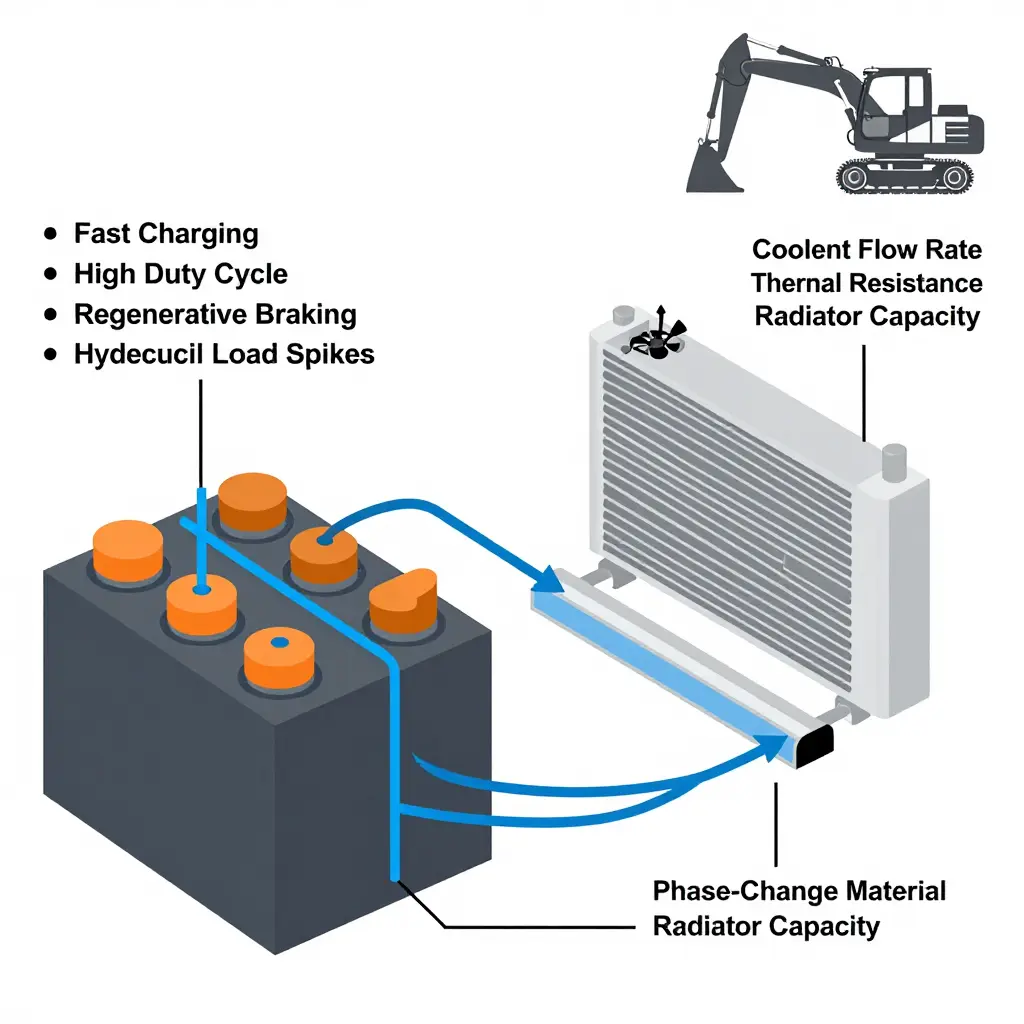
Heat arrives from several sources at once. On an excavator, four of them overlap:
- Fast charging – high current during opportunity charging drives up internal resistance losses sharply.
- High duty cycles – continuous digging, lifting, and swinging keeps the pack discharging near its limit for hours.
- Regenerative braking – energy recaptured during swing deceleration is pushed back into the pack, generating heat on the way in as well as the way out.
- Hydraulic load spikes – sudden pressure demands pull short, intense current bursts that spike localized temperatures.
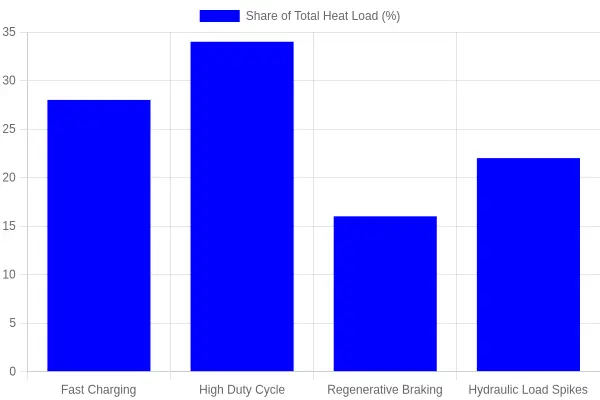
Battery pack heat load is the total thermal energy (in watts or kilowatts) the pack must reject per unit time to stay inside its safe operating window. It is the sum of every source above at the worst-case moment, not a daily average.
Cooling Approaches: Liquid, Air, and Phase-Change
Each method trades cost, complexity, and cooling density.
| Approach | Best Fit | Trade-Off |
|---|---|---|
| Air cooling | Light-duty, low-ambient machines | Simple, but poor heat rejection in summer |
| Liquid cooling | Most hybrid excavators | High cooling density, needs pumps, hoses, seals |
| Phase-change material | Buffer during spikes and standby | Adds mass, absorbs peaks, not steady-state load |
Liquid cooling dominates because it moves heat away from cells far faster than air, keeping both cell and coolant temperatures under control. Phase-change materials are usually paired with liquid loops to shave peak spikes rather than replace them.
Sizing the System: The Numbers That Matter
Three parameters decide whether the pack survives a heat wave:
- Coolant flow rate – too low and the coolant arrives hot, too high and you waste pump power and pressure drop.
- Radiator capacity – must reject the worst-case heat load at the worst-case ambient, not at 25°C.
- Thermal resistance – the bottleneck between cell and coolant; a good contact interface lowers it and lets you run a smaller, cheaper system.
Hybrid excavator cooling system sizing is the process of matching coolant flow rate, radiator capacity, and thermal resistance so the pack stays under its target temperature at the worst-case ambient and duty cycle. Get any one of the three wrong and the machine runs fine in spring, then quietly derates in August.
What the Sizing Has to Beat
A loop sized to average conditions has no margin left when a heat wave arrives. Model the peaks, then build the cooling loop around the load it will actually see.
How the Cooling Loop Actually Flows
A hybrid excavator’s battery thermal management system is a closed loop that moves heat away from the cells and dumps it into ambient air. Four components do the work, running in a continuous circle:
- The battery pack – the heat source. Every charge and discharge cycle generates waste heat inside the cells, and that heat has to leave fast enough to keep temperatures inside the safe window.
- The coolant pump – the mover. It pushes coolant through the loop at a flow rate that must match the heat load, not just the pipe diameter.
- The radiator – the rejector. This is where the heat finally escapes to the surrounding air through fins and airflow.
- The control unit – the brain. It reads temperature sensors and modulates pump speed and fan behavior so the loop reacts to real conditions instead of a fixed assumption.
The schematic below traces coolant flow around the closed circuit. Most summer failures trace back to a mismatch somewhere along this path.
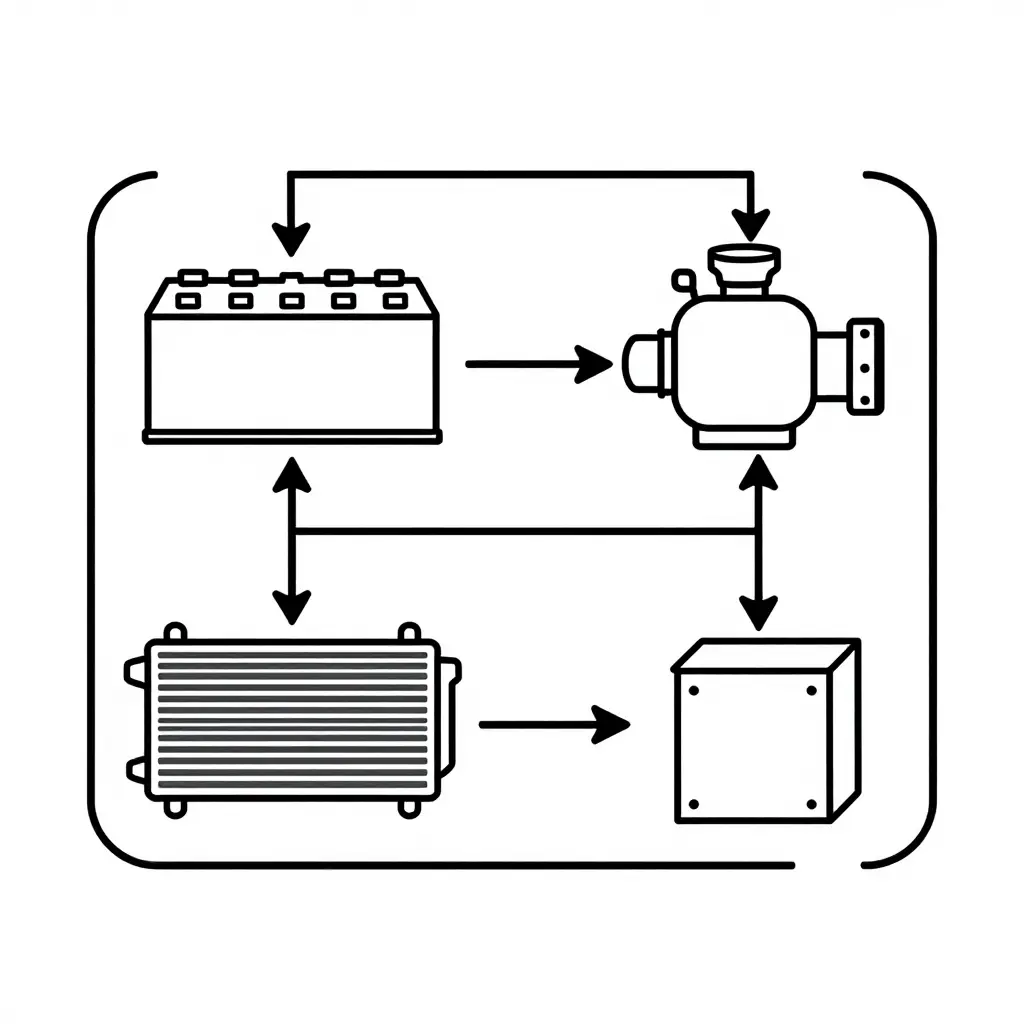
Because the loop is one connected chain, a single weak link – a weak pump, a cramped radiator, or a control unit tuned to mild weather – can strangle the whole system once ambient temperatures climb.
Common Thermal Sizing Mistakes That Only Surface in Summer
Battery thermal management systems on hybrid excavators can look adequate during spring commissioning and then fail the moment a heat wave arrives. These sizing mistakes stay invisible in mild weather and only surface as summer overheating on the jobsite. The culprits engineers and fleet managers run into most often:
-
Underestimating peak heat load. A loop sized around steady-state digging has no headroom when the machine trenches, lifts, and swings at once, which is exactly when heat load peaks.
-
Sizing for average rather than peak ambient temperature. A loop built around a comfortable 25°C “average” collapses at 40°C, because heat rejection capacity shrinks as ambient rises.
-
Ignoring derating thresholds. Every pack has temperature limits above which the BMS cuts power. Treat those thresholds as theoretical instead of as design drivers and operators discover the limit only when the machine slows mid-task.
-
Undersized radiators. A radiator that fits the packaging envelope cannot necessarily reject the required heat; the shortfall surfaces on the hottest afternoons.
-
Insufficient coolant flow at low pump speeds. Many loops are validated at full pump speed, but real duty cycles run the pump slowly. The resulting flow deficit causes summer overheating that a calm lab test never shows.
-
Overlooking dust and debris fouling of heat exchangers. Construction sites coat fins with dust, and a fouled core can lose a large share of its capacity. Fouling quietly compounds every other weakness in the loop.
Validate the battery thermal management system against worst-case summer conditions rather than pleasant averages. Otherwise summer overheating will find the gap for you.
Use this matrix to compare how each sizing philosophy behaves once ambient temperatures climb above 35°C, the point where undersized systems fall apart. Compare it against the symptoms you are seeing in the field.
| Configuration | Peak Heat Load Margin | Summer Performance | Energy Penalty | Maintenance Impact |
|---|---|---|---|---|
| Undersized | Minimal (under 10% above design peak); no buffer for ambient or duty-cycle spikes | Rapid derating above 35 C; interrupted dig cycles and forced cooldown stops | Low steady-state draw, but throttling cuts hybrid assist and raises fuel burn | Frequent over-temp alarms, faster coolant breakdown, shortened pack life |
| Properly sized | 20-30% headroom above sustained peak, validated against worst-case ambient | Holds rated duty cycle at 40 C with stable cell temperatures | Predictable parasitic load (roughly 3-6% of engine output) | Standard service intervals; even component wear |
| Oversized | Greater than 50% headroom; large radiator, fan, and pump capacity | Excellent thermal control with negligible derating in any climate | High parasitic draw from oversized fans and pumps, worst in mild weather | More components to service, accelerated fan and pump wear, added weight and cost |
Why Summer Exposes Thermal Sizing Mistakes
Battery thermal management systems on hybrid excavators are sized against a design point, not a true worst case. When that point assumes mild weather, the system looks healthy for most of the year – until a heat wave breaks the assumptions and a months-old sizing error turns into a derated machine.
The Shrinking Temperature Differential
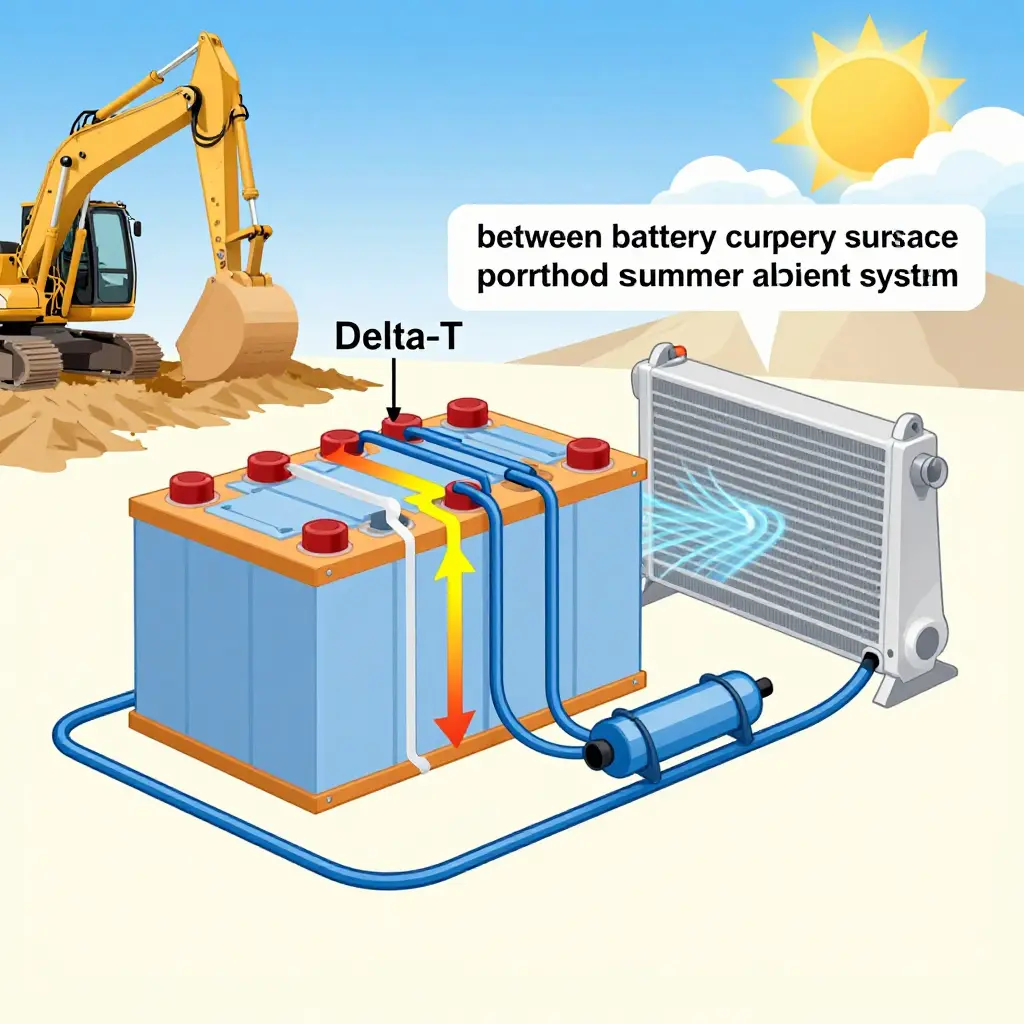
Heat transfer is driven by the gap between battery temperature and the surrounding air. On a 20°C day, a pack running at 35°C delivers a 15°C driving differential. Push ambient to 38°C and that same pack drifts toward 45°C, leaving only a 7°C gap. Convective and radiative rejection scale with that differential, so a cooler that looked generously oversized in spring can reject less than half the heat in summer.
Hotter Heat Exchanger Inlets
The air reaching the radiator or chiller is not ambient – it is preheated by the engine, hydraulic pack, and neighboring components. On hot days that inlet air can run 10-15°C above ambient, so the effective cooling medium is far warmer than the original sizing calculation assumed. Capacity falls even before the weather itself is considered.
Higher Duty Cycles on Hot Days
Heat, not just workload, drives duty cycle. Operators push machines harder during long summer shifts, and every additional charge and discharge cycle adds losses the pack must shed. Peak demand rises exactly when the cooling reserve is thinnest. Teams that rely on on-site maintenance to keep units productive often find thermal limits surface during those peak weeks.
Longer Continuous Operating Periods
Cooler seasons hide weak systems because they give the pack time to recover between loads. Summer shifts run longer without meaningful cooldown, so heat accumulates instead of dissipating – a slow thermal climb that ends in derating or a hard cutoff.
How the Margin Collapses
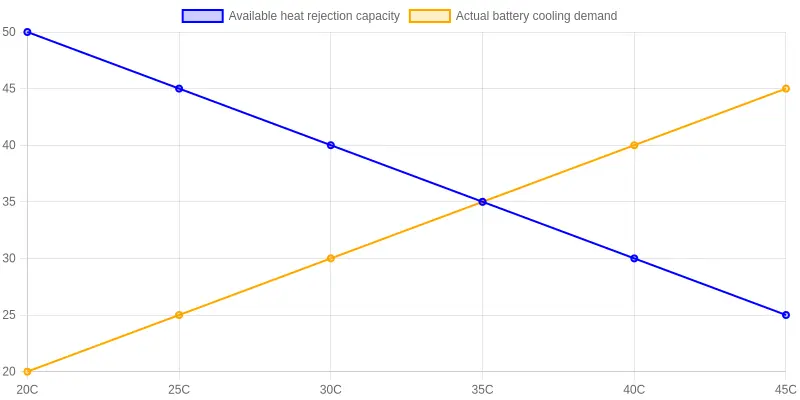
The design margin is not a fixed buffer; it erodes from both ends at once. Available heat rejection falls as ambient rises while cooling demand climbs, and the two curves cross earlier than the rated point suggests. That is where ambient temperature derating becomes visible: a system that met spec on paper can no longer hold battery temperature and has to cut power to protect the cells.
What the Margin Chart Shows
This chart is worth showing any fleet owner who insists the cooling package is “oversized.” It plots two lines against ambient temperature, and the point where they cross is the whole story.
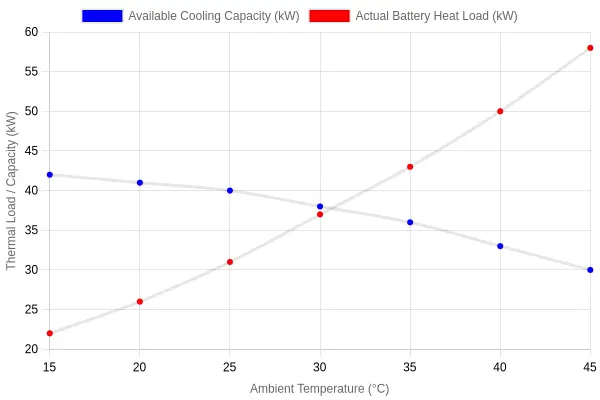
On the left side of the graph – a 15°C spring morning – Available Cooling Capacity sits at about 42 kW while Actual Battery Heat Load sits at roughly 22 kW. That 20 kW gap is the sizing margin, and on paper it looks comfortable.
Then summer arrives.
What Happens as Ambient Climbs
| Ambient Temp (°C) | Available Cooling Capacity (kW) | Actual Heat Load (kW) | Margin (kW) |
|---|---|---|---|
| 15 | 42 | 22 | +20 |
| 20 | 41 | 26 | +15 |
| 25 | 40 | 31 | +9 |
| 30 | 38 | 37 | +1 |
| 35 | 36 | 43 | -7 |
| 40 | 33 | 50 | -17 |
| 45 | 30 | 58 | -28 |
As the temperature rises, the two forces move in opposite directions:
- Cooling capacity drops as ambient temperature rises, because a radiator or chiller is only as good as the temperature difference it can work with. Hot air cannot carry heat away efficiently, so nameplate capacity quietly erodes.
- Battery heat load climbs steeply, driven by higher internal resistance, more aggressive current draw, and the added demand of the cabin and hydraulic system on a hot jobsite.
Where the Lines Cross – and Why It Matters
The crossing point, between 30°C and 35°C, is the thermal break-even. Below it, the system self-regulates and a winter commissioning test looks fine. Above it, the cooling package cannot keep up. The battery does not simply run a little warm – it begins a slow, compounding climb that triggers derating, cuts hydraulic performance, and eventually forces a shutdown.
A machine can pass its acceptance trials in a cool shop and still fail on a 38°C afternoon. The margin was never really there; mild weather was hiding it.
Where to Size the System
Design the cooling package around the right-hand side of this chart, not the left. A system specified at the spring-morning operating point carries 20 kW of margin that is gone by early July. Sizing to the true summer worst case, then adding a deliberate buffer on top, is what keeps a machine working through the season instead of parked in August.
Derating, Duty Cycle, and Control Logic: The Three Forces Behind Thermal Sizing
Thermal sizing of a hybrid excavator’s battery pack is never a single-number decision. It comes from three moving parts: how the pack derates, how hard the machine works, and how the control system responds. Misjudge any one of them and the error stays invisible until a heatwave exposes it.
Battery Derating: The System’s Own Brake
Battery derating is the automatic reduction of available power once cell temperatures cross a safe threshold – typically around 45°C for many lithium-ion designs. The battery management system tapers current to protect the cells, so the machine loses hydraulic response and swing torque exactly when the operator needs it most. A pack that looked “plenty big” on a spec sheet may deliver only 60 to 70 percent of rated power by mid-afternoon.
High Duty Cycle Accelerates Heat Accumulation
The hybrid excavator duty cycle is what separates a gentle test day from a production shift. Trenching, mass excavation, and continuous truck loading keep the pack cycling through high-current bursts with almost no cooling recovery time. Heat accumulates faster than passive or air-cooled designs can reject it, so temperature climbs steadily across the shift instead of settling at a stable plateau.
[Visualization to insert here: a line chart titled “Battery Power Output vs. Cell Temperature (Derating Curve).” The X-axis plots cell temperature from 20 to 60 degrees Celsius; the Y-axis plots available power output as a percentage of rated capacity. The line stays flat at 100 percent until 45 degrees Celsius, then declines to roughly 70 percent at 50 degrees, 55 percent at 55 degrees, and 40 percent at 60 degrees, with a marker labeled “Derating threshold” at the 45-degree point.]
Control Logic Can Mask the Real Problem
Control logic is both the clever part and the dangerous part. A well-tuned strategy blends engine and electric power smoothly enough that derating goes unnoticed. A poorly tuned one does the opposite: in mild weather it stretches battery headroom, hides undersized cooling, and produces performance numbers that make the pack look adequate.
In summer the same machine hits its thermal ceiling. The masking strategy collapses into hard derating, and the underlying sizing mistake – an undersized cooler, a thin heat sink, or an optimistic duty profile – shows through.
Sizing has to be validated at realistic ambient temperatures, not only in a controlled lab. Thermal-loop maintenance matters as much as the original specification, because even properly sized hardware loses efficiency as cooling components degrade. For operations that depend on uptime, pairing good thermal design with reliable on-site repair support keeps derating from turning a productive shift into a stalled one.
How Heat Actually Leaves a Hybrid Excavator Battery Pack
On paper, thermal management looks like a single number: a cooling capacity in kilowatts. In the field, it is a chain of heat-transfer steps, and every link has a limit. Heat leaves the cells by conduction into a cooling plate or cold plate, is carried away by coolant transport through the loop to the radiator or chiller, and finally leaves the machine through convection into the ambient air.
When summer air temperatures climb, that last step – the convective rejection to ambient – becomes the bottleneck. The coolant loop can only dump heat as fast as the surrounding air allows, so pack temperature drifts upward, the BMS starts derating charge and discharge limits, and the duty cycle quietly shrinks. A system sized on a mild spring day can look adequate on a spec sheet and still fail on a 38°C jobsite afternoon.
The schematic below strips the system down to its core pathway. A battery pack feeds heat into the thermal management loop, which transports it and rejects it to the ambient environment – the chain that determines when derating kicks in and how hard you can actually work the machine.
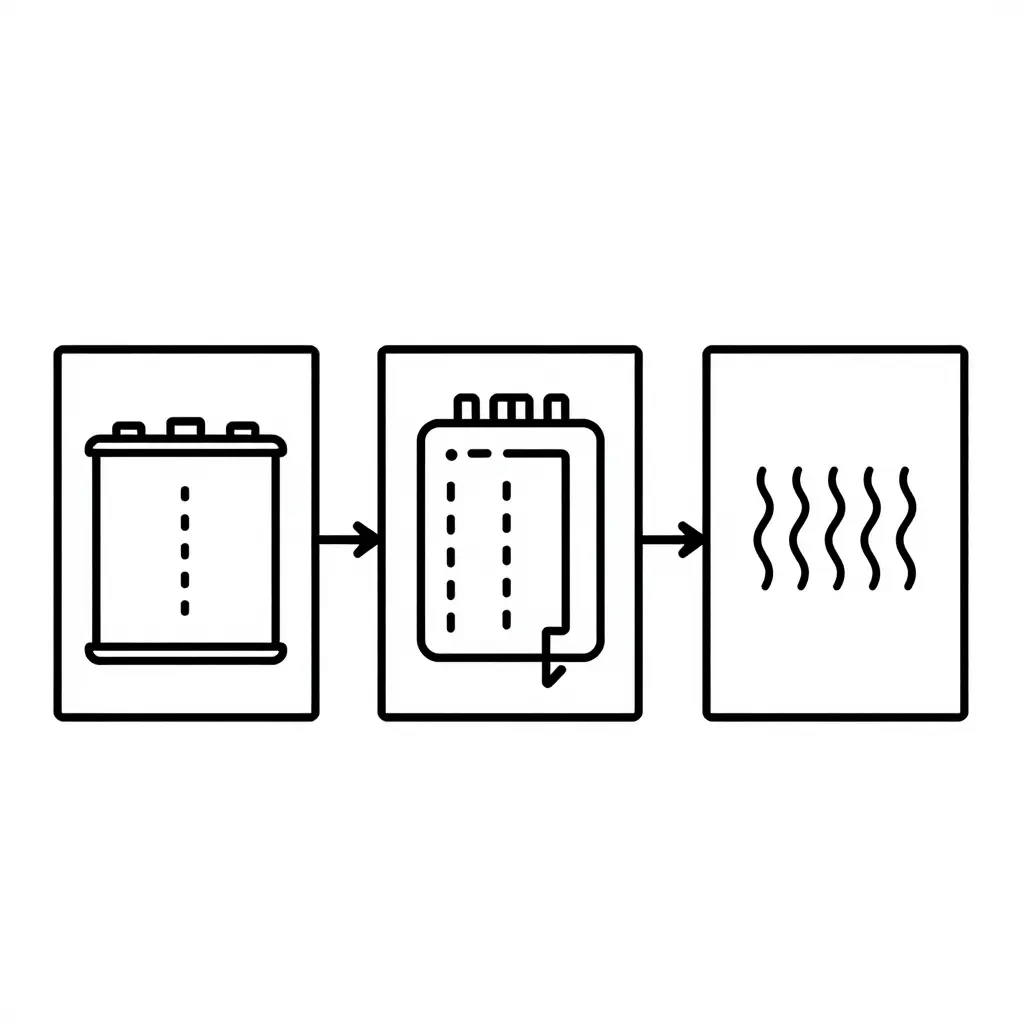
Conduction moves heat out of the cells, coolant transport carries it to the heat exchanger, and convection releases it into the air. A weakness in any one arrow limits the whole chain, and on a hot day that limit shows up as an earlier, more aggressive derate.
Before the Heat Arrives: A Sizing Verification Checklist
Summer exposes every optimistic assumption in a hybrid excavator’s battery thermal management design. Before temperatures climb, work through this thermal sizing verification sequence to confirm the system can keep up.
- Measure real-world peak heat loads. Instrument the pack during a representative duty cycle and capture actual cell and coolant temperature spikes, not just the numbers from a spec sheet. Field duty cycles are usually harsher than lab profiles.
- Test at high ambient temperatures. Push the machine through a full work shift with ambient conditions near or above your site’s summer maximum, and log how quickly the system reaches its steady-state thermal ceiling.
- Review coolant flow margins. Confirm pump capacity and channel flow rates still deliver adequate velocity and pressure drop when viscosity and demand peak, leaving genuine headroom rather than operating at the edge.
- Check heat exchanger fouling. Inspect the radiator and any air-to-liquid exchangers for dust, mud, and debris. A partially clogged core silently steals cooling capacity long before performance visibly drops.
- Confirm derating thresholds. Verify the exact temperatures where the controller throttles power or charging, and check these align with what operators and maintenance crews expect during long summer shifts.
Reading the Results
Read the data as a margin question, not a pass/fail test. If peak cell temperatures sit comfortably below derating thresholds with cooling capacity to spare, the sizing is sound. If the system approaches its limits on a normal day, it has no buffer for a heatwave, a heavy attachment, or a slightly fouled exchanger, and power will drop when productivity matters most. Manufacturers such as Zoomlion deliberately build in thermal headroom for this reason: site conditions rarely match the ideal, and a sizing that only works in spring is a sizing that fails in July.
Any margin under roughly ten percent is a signal to act: increase cooling capacity, improve airflow, or revise duty-cycle assumptions before the season stresses the machine.
Frequently Asked Questions: Battery Thermal Management on Hybrid Excavators
Why do thermal problems only appear in summer?
Cooling margins are usually adequate in spring and fall, so weak spots stay hidden. Summer raises ambient air temperature, which shrinks the temperature gap between the battery pack and the surrounding air. Once that gap narrows, the same workload demands far more from the hybrid excavator cooling system, and any shortfall in radiator surface, fan capacity, or coolant flow becomes visible as derating, alarms, or slowed fast charging. The design flaw was always there; heat simply exposed it.
How can I tell if a hybrid excavator cooling system is undersized?
Look for repeatable patterns rather than one-off events. Warning signs include pack temperature climbing during the afternoon peak but recovering overnight, power derating above roughly 35°C, coolant returning hot, and fans running at full speed with little effect. If you log battery temperature against ambient temperature and see it tracking upward in parallel, the system lacks reserve capacity for your actual duty cycle.
Is retrofitting extra cooling capacity feasible?
Often yes, but it is an engineering task, not a simple parts swap. Practical options include a larger radiator core, higher-flow fans, upgraded coolant pumps, revised ducting, and smarter control logic that pre-cools before peak load. Size the upgrade against measured heat rejection rather than guesswork. A properly specified retrofit can restore full performance without replacing the battery.
How does ambient temperature affect battery life?
Heat accelerates cell aging. Sustained operation above the manufacturer’s recommended window chemically degrades lithium cells faster, permanently reducing usable capacity and cycle life. Every extra degree of average temperature compounds across thousands of operating hours. Good battery thermal management keeps cells in their happy zone, protecting both runtime today and resale value later.
Conclusion: Sizing and Verifying Thermal Systems Before Summer Exposes Them
Battery thermal management on hybrid excavators is a year-round engineering discipline; its weaknesses simply become visible when the weather turns hot. Undersized cooling loops, sizing that ignores true peak loads, and reactive troubleshooting all converge in summer to produce derated performance, accelerated cell degradation, and costly downtime on the job site.
Sizing around real peak duty cycles rather than comfortable averages keeps battery temperatures inside safe operating windows even during sustained digging and lifting in high ambient heat. Peak-based design lets the cooling system absorb worst-case thermal loads, not merely steady-state ones. And logged temperature data, scheduled inspections, and early intervention turn thermal management from firefighting into planned, predictable maintenance.
Manufacturers with deep engineering experience make that easier. Zoomlion, founded in 1992 and listed in Shenzhen and Hong Kong, has designed construction machinery for demanding environments for decades, and that experience shows in how its machines handle battery thermal control.
Teams looking to extend uptime beyond the battery bay can also study proven approaches to on-site truck repairs, while fleet managers reviewing the bigger operational picture may benefit from understanding freight efficiency and weight considerations. Both complement a solid thermal strategy.
Summer does not invent thermal problems; it reveals them. Sized correctly, designed around peak demand, and verified proactively, a hybrid excavator’s battery system should carry its workload through the hottest months without drama.