A trailer’s certification label rarely gives you the number you need. For truck owners, fleet managers, and commercial vehicle operators, the gap between what a trailer claims it can carry and what it can safely haul in daily service is where expensive mistakes start.
The GVWR plate is the manufacturer’s certification label. GVWR stands for gross vehicle weight rating: the maximum total weight of the trailer plus its cargo, as configured at the factory. Real payload is what is left for cargo after you subtract the trailer’s base weight, fuel, and added equipment from that rating. Axle rating is the maximum load a single axle assembly is engineered to support, and it often turns out to be the real limit.
The mistake follows a predictable pattern. An operator reads the GVWR plate, subtracts the empty weight, treats the difference as usable capacity, and loads to that number. If the axle rating is lower than the arithmetic suggests, the trailer is overloaded both legally and mechanically under federal and state trailer weight regulations. Tires, brakes, suspension, and bearings take stress they were never designed for, and the damage shows up as premature wear, failed inspections, fines, and poor handling.
The sections below cover how to read the GVWR plate correctly, why the axle rating often sets a lower payload ceiling than buyers expect, and how to calculate usable capacity before you load a single pallet.
GVWR vs. GAWR, Curb Weight, and Real Payload
Four numbers govern how much a truck or trailer can legally carry: curb weight, real payload, GVWR, and GAWR. They are related but not interchangeable, and mixing them up is a common buying mistake.
The four terms, defined
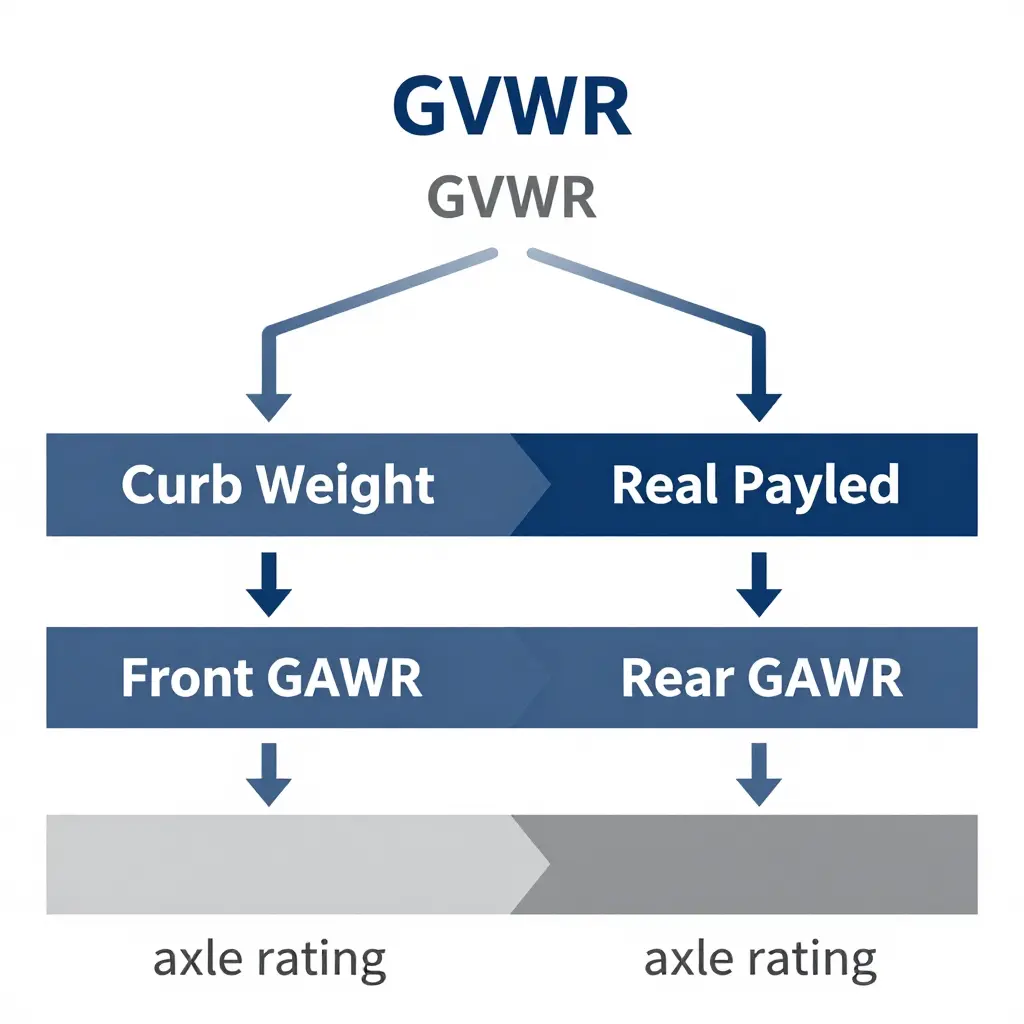
Curb weight is the weight of the empty vehicle with standard equipment and full fluids, but no cargo. Real payload is what remains for cargo and passengers once you subtract curb weight from the maximum total weight. GVWR (Gross Vehicle Weight Rating) is that maximum total weight of the loaded vehicle. GAWR (Gross Axle Weight Rating) is the maximum weight a single axle is rated to carry.
| Term | What It Measures | How It Is Set |
|---|---|---|
| Curb weight | Empty vehicle with fluids and standard equipment | Manufacturer spec |
| Real payload | Cargo capacity = GVWR minus curb weight | Derived figure |
| GVWR | Maximum total weight of the loaded vehicle | Certified legal limit |
| GAWR | Maximum weight on one axle | Certified axle rating |
How the numbers interact
GVWR equals curb weight plus real payload. The axle ratings work alongside that total, because the front and rear GAWRs together have to support the whole vehicle. Real payload runs out when either the GVWR or a single axle rating is reached first; whichever hits its ceiling sooner is your limit.
Why the plate is a legal limit, not a performance claim
The GVWR plate is a certified figure, set by the manufacturer after structural and safety testing. It marks a compliance threshold, not a statement about what the vehicle can handle. Exceeding it can affect road legality, insurance coverage, and liability, regardless of how the truck feels. For how these categories are organized, see trailer and truck weight classifications.
Why the plate often exceeds what you can carry
The number on the plate describes the whole vehicle, not the cargo. Subtract curb weight and any added equipment, and the remaining real payload is always smaller. Load distribution matters as well: you can exceed a single axle rating before the total reaches GVWR. Tongue or pin weight from a trailer also consumes payload rather than adding to it. Staying within tractor-trailer weight regulations means checking all four figures, not just the largest one on the plate.
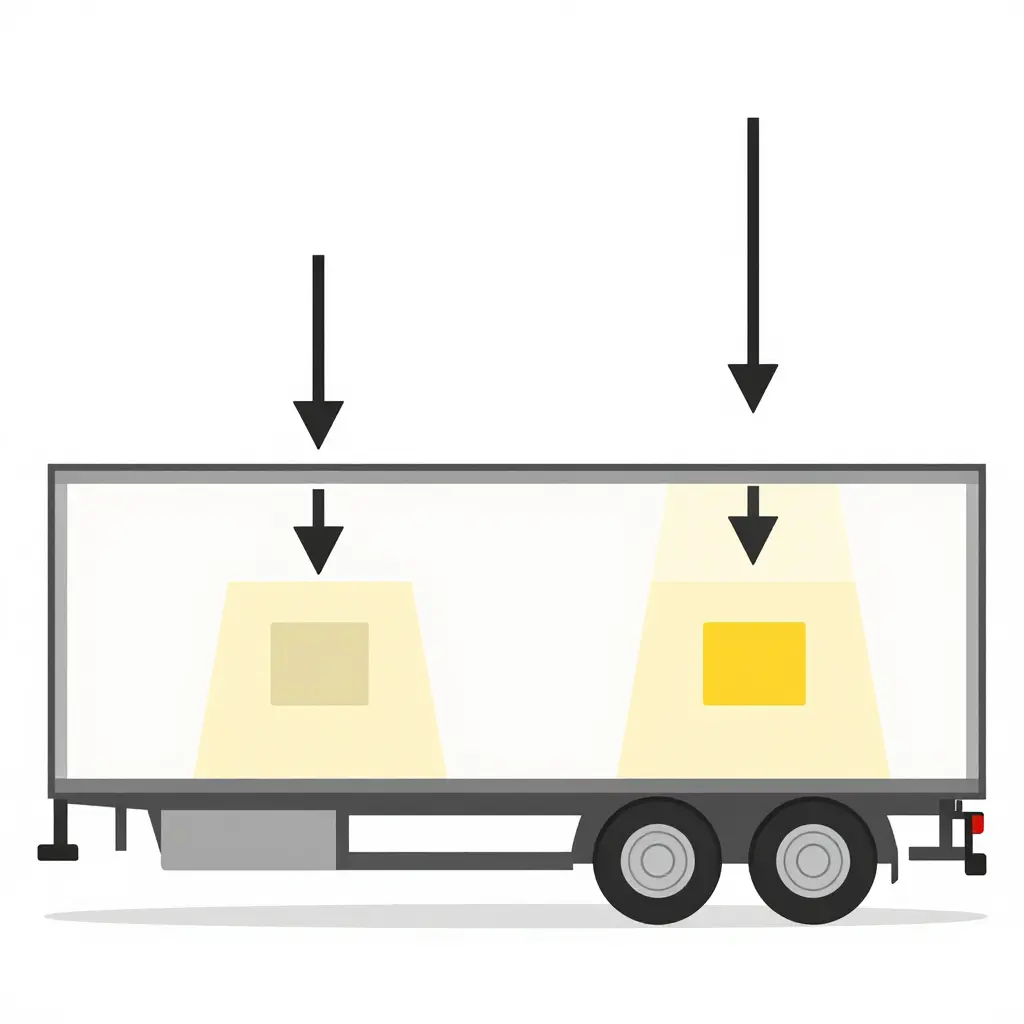
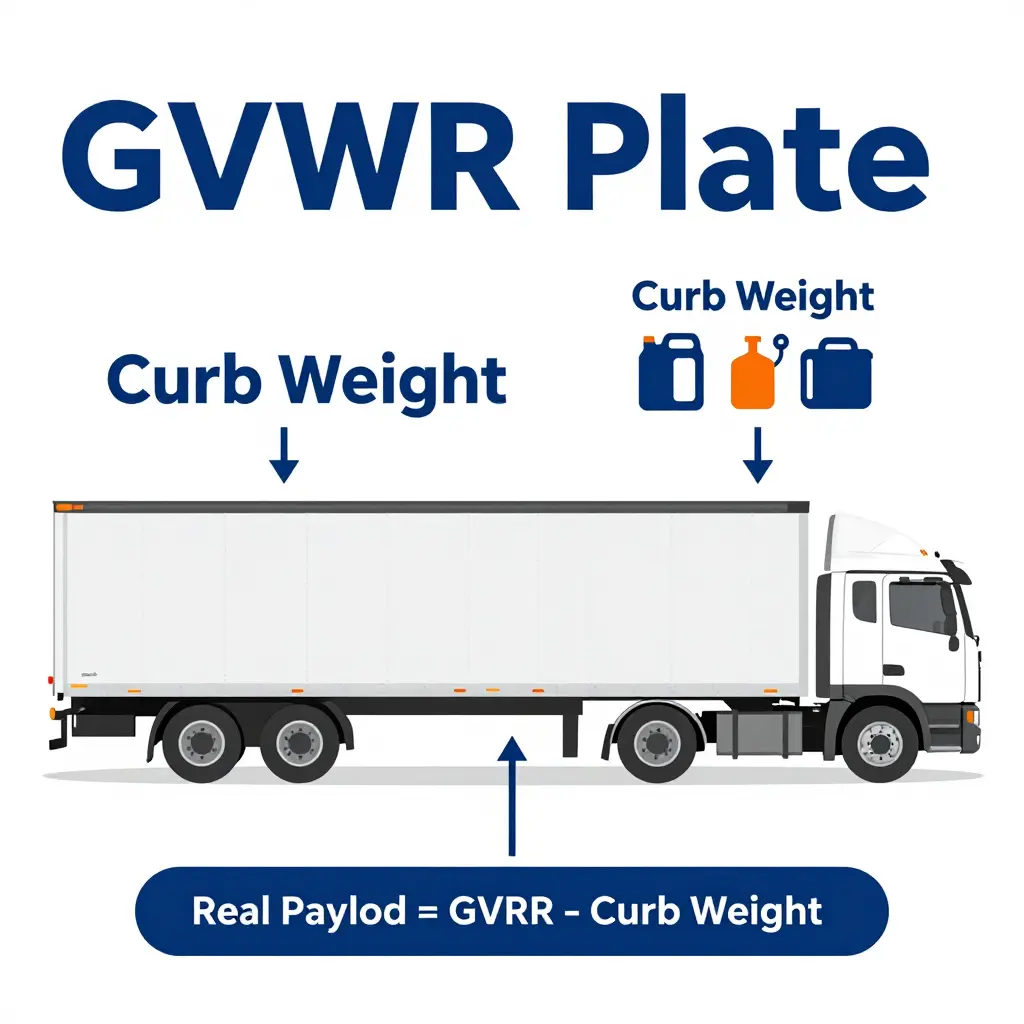
As this schematic illustrates, the GVWR plate on the trailer body sets the total legal limit, but the payload you can safely carry is capped by the axle rating of each axle group, which is why matching the two matters when you buy.
The Axle Rating Mistake: When the GVWR Plate Overpromises Your Real Payload
On the lot, most buyers read one number first: the GVWR plate. It is stamped on the door jamb, printed on the spec sheet, and quoted in every sales pitch. The logic seems airtight: a higher GVWR must mean more usable cargo, right? Not always. That assumption is the axle rating mistake, and it pushes rigs over their legal and mechanical limits every year.
GVWR, or Gross Vehicle Weight Rating, is the maximum the whole combination is allowed to weigh: tractor, trailer, fuel, and cargo combined. It caps the total, not where that weight can sit. The Gross Axle Weight Rating (GAWR) governs the individual axles and axle groups, and those limits frequently become the binding constraint long before the total approaches the GVWR.
Why the axle – not the plate – sets the real ceiling
- A rig can be fully GVWR-compliant and still be illegally heavy on a single axle group. A steer axle rated at 12,000 lb does not care that your total weight looks fine on paper.
- The real payload is set by the lowest-rated component in the load path, usually an axle group rather than the gross figure bolted to the door.
Poor load placement is the usual culprit. Shift cargo toward the nose of the trailer and the tractor’s steer and drive axles absorb the extra weight. Stack it too far back and the trailer axles take the hit instead. Because weight transfer is dynamic, a load that scales perfectly on a static pad can still overload one axle group once the vehicle is rolling, braking, or climbing a grade.
The consequences of ignoring this distinction compound quickly:
- Faster, uneven tire wear and dangerous heat buildup
- Longer stopping distances as brake capacity is exceeded
- Reduced steering authority and straight-line stability
- Roadside fines for axle violations even when the gross reading passes inspection
The fix is simple and rarely done: weigh each axle group separately, not just the total. Before your next purchase, review this guide to tractor-trailer weight regulations to see how the limits interact across the full combination.
GVWR vs. Real Payload: A Side-by-Side Look
Before you compare trailers, it helps to know what each column measures. The GVWR plate rating is the maximum weight the trailer is legally rated to handle, and it includes the weight of the trailer itself. Typical curb weight is what the empty trailer really weighs on a scale. Real payload capacity is the cargo you can load once you subtract curb weight from the rated limit, and it is often trimmed further by the 80,000 lb federal gross combination limit and by how heavy the tractor in front of it happens to be. Finally, typical axle rating (GAWR) is the maximum weight a single axle assembly is engineered to support, and it frequently sets the ceiling on how much a trailer can haul no matter what the plate says.
| Trailer Type / Class | GVWR Plate Rating | Typical Curb Weight | Real Payload Capacity | Typical Axle Rating (GAWR) |
|---|---|---|---|---|
| 53 ft Dry Van (Class 8) | 68,000 lb | 13,500 lb | 42,000 – 45,000 lb | 40,000 lb (tandem, 2 x 20,000) |
| 48 ft Flatbed | 55,000 lb | 11,000 lb | 43,000 – 44,000 lb | 40,000 lb (tandem, 2 x 20,000) |
| 53 ft Refrigerated Van (Reefer) | 68,000 lb | 16,500 lb | 38,000 – 40,000 lb | 40,000 lb (tandem, 2 x 20,000) |
| 48 ft Step Deck (Drop Deck) | 60,000 lb | 12,000 lb | 42,000 – 44,000 lb | 40,000 lb (tandem, 2 x 20,000) |
| 40 ft Grain Hopper (Bulk) | 68,000 lb | 12,500 lb | 45,000 – 48,000 lb | 40,000 lb (tandem, 2 x 20,000) |
| 42 – 45 ft Tanker (Liquid Bulk) | 68,000 lb | 14,000 lb | 42,000 – 46,000 lb | 44,000 lb (tandem, 2 x 22,000) |
The Takeaway: Mind the Gap Between the Plate and the Payload
The GVWR plate is a ceiling, not a promise. A trailer can carry a 68,000 lb plate and still move only 40,000 lb of freight once you account for its own curb weight, the tractor in front of it, and the federal gross combination limit. The heaviest tare weights cost the most: the refrigerated van, at roughly 16,500 lb empty, gives up about 3,000 lb of cargo capacity next to a 13,500 lb dry van and more than 5,000 lb next to an 11,000 lb flatbed. The axle rating tells the same story from below: a tandem limited to 40,000 lb caps your load long before the plate becomes the deciding factor. When you shop, always pair the plate number with the empty weight and the GAWR so the payload figure you plan around is real rather than theoretical. For a deeper walkthrough of how these classes and ratings are defined, see this guide to trailer truck weight classifications.
Calculating Real Payload Correctly
A weight ticket is only as good as the math behind it. Working out real payload from the ground up keeps your trailer legal, safe, and profitable.
Start With the Core Formula
The foundation is simple:
Real payload = GVWR – curb weight
- GVWR is the maximum total weight the trailer is rated to carry, including cargo, fuel, fluids, and everything bolted on.
- Curb weight is the trailer as it sits empty, but with full fluids, mounted equipment, and accessories already on board.
Subtract curb weight from GVWR, and what remains is your real payload. Everything else you add comes straight out of that number.
Count Every Accessory and Fluid
This is where the surprises come from. Toolboxes, ramps, tarps, liftgates, spare tires, E-track, refrigeration units, and generators all add curb weight, and so do fuel and hydraulic fluid.
Add them first, then recalculate. A trailer that looked generous on paper can shrink fast once real equipment is mounted.
Validate Against the Axle Rating
The GVWR plate only tells you the total ceiling; it does not tell you how that weight is distributed. That is why the axle rating often sets the true limit.
If cargo sits too far forward or back, one axle can overload long before the GVWR is reached. Always check:
- Each axle’s rated capacity
- Tongue or kingpin weight for the towing vehicle
- Your trailer’s own stated capacity
A Quick Worked Example
| Step | Item | Weight (lb) |
|---|---|---|
| 1 | GVWR | 25,000 |
| 2 | Curb weight (empty, with fluids) | 9,500 |
| 3 | Real payload (Step 1 – Step 2) | 15,500 |
| 4 | Accessories + mounted equipment | 1,200 |
| 5 | Usable payload (Step 3 – Step 4) | 14,300 |
The axle rating can cap that 14,300 lb figure even lower. The GVWR plate is the roof; the axles are the floor each load actually rests on.
Why the Axle Rating Wins
When the axles say stop, you stop, no matter what the GVWR plate reads. Matching your trailer to the load starts with choosing the right trailer size for your cargo profile and axle configuration.
Get the formula right and weigh everything honestly, and the axles will have the final word.
GVWR Plate vs. Real Payload: Where the Numbers Fall Apart
The chart below puts the numbers side by side so you can see the story a spec sheet never tells you. The taller, darker bar is the GVWR plate figure, the ceiling stamped on the compliance label. The shorter, lighter bar is the real payload your trailer actually hauls once its own weight and its axle rating get their say.
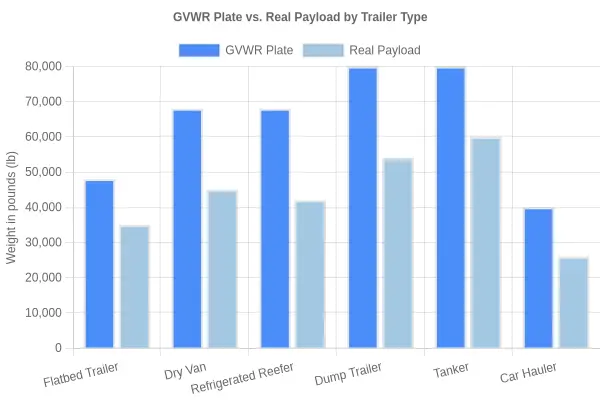
The visible gap between each pair of bars represents the weight consumed by the trailer itself and by axle rating constraints, the cargo capacity you never actually get to use.
A dry van is the clearest case: a 68,000 lb plate sounds generous until the 45,000 lb real payload shows that 23,000 lb is unavailable to cargo, most of it the trailer’s own weight and the rest axle and combination limits. The reefer loses the largest share of its plate, 26,000 lb, and the car hauler gives up about a third of its rated figure, 14,000 lb. This is the trap that catches buyers who shop the plate instead of the platform. Before you sign anything, dig into the trailer truck weight classifications that govern each category so the gap never surprises you at the scale house.
Reading the Bars at a Glance
| Trailer Type | GVWR Plate (lb) | Real Payload (lb) | Gap (lb) |
|---|---|---|---|
| Flatbed Trailer | 48,000 | 35,000 | 13,000 |
| Dry Van | 68,000 | 45,000 | 23,000 |
| Refrigerated Reefer | 68,000 | 42,000 | 26,000 |
| Dump Trailer | 80,000 | 54,000 | 26,000 |
| Tanker | 80,000 | 60,000 | 20,000 |
| Car Hauler | 40,000 | 26,000 | 14,000 |
The plate is a legal limit, not a promise of capacity. Size your fleet around the real payload, and the axle ratings underneath it, or you will find yourself turning away loads you thought you were built to carry.
Before you hand over your money for any trailer, knowing how to verify its genuine capacity will protect you from overload fines, premature wear, and costly breakdowns. Our guide on what to check when buying a truck trailer covers the bigger picture, while the checklist below gives you the hands-on steps.
The Operator’s Verification Checklist
- Read the GVWR plate. Find the manufacturer’s certification label, usually riveted to the front-left side of the trailer frame, and write down the Gross Vehicle Weight Rating (GVWR) it lists.
- Record every GAWR decal. Locate the Gross Axle Weight Rating for each axle or axle group, because these individual limits often cap your load long before the overall GVWR does.
- Confirm the tire and wheel ratings. Check that the load range and speed rating printed on each tire can support the axle weight you intend to carry, since under-rated rubber shrinks your legal capacity.
- Weigh the empty trailer. Take the rig to a certified scale with full fuel, fluids, and any permanent equipment so you capture a realistic empty (tare) weight rather than a guessed figure.
- Calculate the real payload. Subtract the measured tare weight from the GVWR, and treat the result as your true working capacity instead of the sticker’s optimistic figure.
- Compare the load to each axle rating. Distribute your intended cargo conceptually and make sure no single axle group exceeds its GAWR once cargo, tongue weight, and accessories are added.
- Check the manufacturer’s documentation. Cross-reference the VIN against build sheets, options lists, and any axle-upgrade records to confirm the trailer left the factory with the ratings you are relying on.
- Verify compliance with local regulations. Match your confirmed numbers against bridge-formula and road-weight rules for the regions you operate in, since legal limits can be stricter than the plate itself.
The GVWR plate is only a starting point. A trustworthy purchase decision depends on weighing the empty trailer, validating each axle rating, and confirming the paperwork before you commit.
Legal, Safety, and Financial Consequences
The number stamped on the GVWR plate sets a vehicle’s legal and mechanical ceiling, and it is not a suggestion. When operators load to a guessed capacity instead of a measured real payload, the gap between the two produces consequences no fleet can absorb quietly.
Overload Fines and Roadside Violations
Weight enforcement is routine. Portable scales appear at weigh stations and along highways, and inspectors compare axle weights against registered limits. A citation escalates with how far a load exceeds the allowable limit.
Repeat violations add points, damage safety scores, and can place a carrier out of service. What triggers these penalties starts with how weight rules apply to your operation, as detailed in the hidden costs of ignoring tractor-trailer weight regulations.
Voided Insurance Coverage
Insurance is priced and issued on declared weights and use. If an axle rating is exceeded in a crash, a claim can be denied on the grounds that the vehicle operated outside its insured condition.
That leaves the carrier personally responsible for damages, injuries, and legal defense. Before signing a policy, review how commercial truck and trailer insurance responds to misdeclared loads.
Accelerated Wear on Axles and Tires
Overloading shortens equipment life in predictable ways. Axles, bearings, springs, and tires each carry rated maximums. Exceeding them accelerates fatigue, raises tire temperature, and increases the chance of a blowout, which means more frequent repairs and unscheduled downtime.
Higher Long-Term Maintenance and Liability Costs
These costs compound. Repeated overloading drives up parts and labor, lowers resale value, and increases exposure to lawsuits after a failure. Factoring in the true payload and staying within the axle rating protects both the equipment and the business.
How Real Payload Actually Adds Up
The sticker on the door jamb tells you one thing. What the truck can legally and safely carry tells you another. To make sense of the gap, it helps to walk through the logic step by step, starting from the manufacturer’s plate and working down to a number you can actually haul.
- Start with the GVWR plate. This is the manufacturer’s stated maximum for the fully loaded vehicle, including the truck, trailer, cargo, fuel, and passengers.
- Subtract the curb weight. Remove the weight of the empty vehicle and anything permanently bolted on. What remains is your theoretical carrying room.
- Check the axle rating and axle group limits. Here is where most buyers slip up. The gross figure can look generous while a single axle or a tandem group becomes the real ceiling.
- Confirm the real payload figure. The lower of the two numbers wins. Real payload is governed by whichever limit is reached first, not by the number that looks best on paper.

Real payload is only confirmed after subtracting curb weight from the GVWR plate and testing the result against each axle rating and axle group limit, since the tightest constraint always governs the final figure.
That final step is where fleet managers lose sleep. A spec sheet can promise plenty of capacity, but if the rear axle group caps out long before the GVWR does, your usable load shrinks fast. Understanding how truck weight classifications map onto axle configuration is a smart way to avoid overbuying capacity you can never legally use.
Fleet Management and Equipment Sourcing Implications
For fleet managers and commercial vehicle operators, inconsistency is the silent budget killer. When every truck and trailer in your yard carries a different axle rating, your dispatchers are essentially guessing at capacity. Standardizing how you verify weights turns compliance from a headache into a routine.
Standardize axle rating and real payload checks
Build one repeatable inspection protocol and apply it to every unit, regardless of age or origin. Start at the GVWR plate, then confirm what the vehicle can truly carry once fuel, tools, and drivers are on board. That gap between the plate number and the real payload is where overload fines and premature wear hide.
A simple fleet checklist keeps everyone honest:
| Check | What to verify | Frequency |
|---|---|---|
| GVWR plate | Matches registration, title, and build sheet | On intake and annually |
| Axle rating | Front, rear, and trailer limits stay within spec | On intake and after any repair |
| Real payload | Loaded weight minus curb weight, per cargo type | Before each dispatch |
| Tires and suspension | Rated for the target load | Monthly |
Keep identical data fields for every vehicle so your reports stay comparable across the whole fleet.
Spec trailers to match intended loads
Don’t buy a trailer and then discover your freight doesn’t fit the spec. Match deck length, axle configuration, and suspension to the loads you haul most often, not the heaviest load you might haul once. When axle ratings fall short of your typical cargo, you either run light or risk enforcement. Aligning trailer specs with daily duty cycles also helps you maximize freight efficiency across your operation.
Why the manufacturer matters
Accurate documentation is only as good as the company behind it. A manufacturer with rigorous engineering and traceable records gives you GVWR plates, axle ratings, and payload figures you can defend to regulators, insurers, and buyers.
Zoomlion, founded in 1992, is a dual-listed construction and agricultural machinery manufacturer. A builder with that kind of record can back its ratings with supporting paperwork. When you source from an established manufacturer, the numbers on the trailer are verifiable rather than assumed.
Frequently Asked Questions: GVWR Plate, Real Payload, and Axle Ratings
What does a GVWR plate actually certify?
A GVWR plate certifies the maximum total weight a trailer is designed to carry, including its own structure, cargo, fluids, and accessories. It reflects the manufacturer’s tested safe operating limit rather than a rough estimate. The same plate also lists the GAWR for each axle and the tire pressure required to support those limits.
Can real payload exceed GVWR minus curb weight?
No. Real payload is capped by GVWR minus the trailer’s curb weight and can never legally or safely pass that figure. Some sellers advertise payload as the difference between GVWR and dry weight, which ignores fluids, options, and accessories. Once you add those items, your usable real payload shrinks further.
Why is the axle rating often the true limit?
The axle rating, or GAWR, is frequently the binding constraint because axle and tire capacity fills up before you reach total GVWR. A trailer can sit well under its GVWR while a single axle is already at or past its limit. That is why you should compare actual load per axle, not just total weight.
How do I find the GAWR?
You’ll find the GAWR on the same GVWR plate or certification label, listed per axle along with tire size and recommended pressure. If the label is missing or unreadable, check the manufacturer’s documentation or the physical axle tag directly. Never assume the GAWR from a similar-looking model, because ratings vary by axle and spring configuration.
What happens if I overload the axles?
Overloading axles leads to bent spindles, cracked springs, tire blowouts, and brake failure, all of which raise crash risk. It also puts you over legal axle weight limits, exposing you to fines and out-of-service orders at inspection. Insurers may deny a claim if an overloaded axle contributed to the accident.
How do I verify payload when buying a used trailer?
Start by reading the GVWR plate and confirming the numbers match the trailer’s actual axles and tires. Then weigh the empty trailer on a certified scale and subtract that from GVWR to get a realistic capacity figure. For a structured walkthrough of the process, review this guide on how to buy a truck trailer with confidence before you commit.
Conclusion: The GVWR Plate Is a Reference, Not the Whole Story
If there is one lesson that ties this entire guide together, it is this: the GVWR plate is where every smart buying decision begins, not where it ends. That stamped number tells you the maximum total weight a trailer is rated to carry when loaded, but it says nothing about how much of that capacity your specific truck is actually left with after accounting for fuel, tools, and equipment. The number that truly governs your day-to-day operation is the real payload, and the figure that keeps you legal and safe on the road is the axle rating, which caps how much weight can rest on the tires and suspension beneath it. Buyers who treat the GVWR as a finish line routinely overload axles, and buyers who ignore all three figures risk fines, damaged components, and unsafe handling.
Your Verification Recap
Before signing, confirm the GVWR against your truck’s actual base weight to calculate true payload capacity, then cross-check that number against the axle rating printed on each axle’s certification label. Weigh the loaded rig on a certified scale, distributing cargo so no single axle exceeds its limit, and repeat that measurement whenever your typical load changes. Keep those three numbers in view, because matching trailer specs to your actual loads is what separates a compliant, durable fleet from one that spends its budget on repairs and penalties.
For a broader walkthrough of the entire purchase process, this guide to buying a truck trailer with confidence puts each verification step into a practical, real-world context.
As trailers evolve with lighter materials, smarter onboard weighing systems, and better load-sensing technology, the gap between advertised ratings and real-world capacity will keep narrowing. Buyers who already understand the difference between a sticker and a scale will be the ones capturing that advantage, turning every trip into a safer, more efficient, and more profitable run.
What a Loaded Trailer Actually Weighs
Before you can trust a single number on a spec sheet, it helps to see where every pound really goes. The doughnut chart below breaks a fully loaded trailer into its four core weight blocks, and it is worth studying closely, because three of those four blocks are weight you carry rather than cargo you get paid to haul.
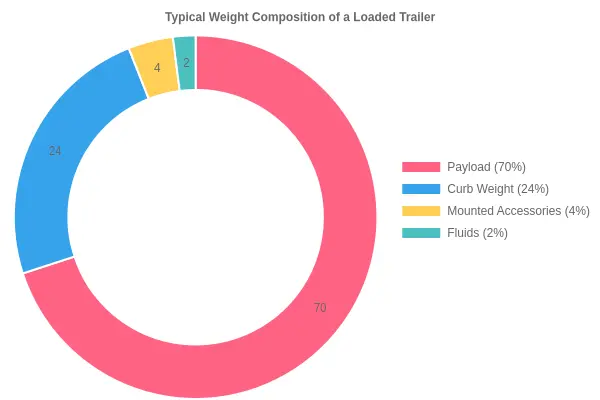
Breakdown of a loaded trailer: payload (70%), curb weight or trailer structure and chassis (24%), mounted accessories or equipment (4%), and fluids or fuel allowance (2%).
Here is how the numbers usually shake out for a general-purpose loaded trailer:
| Weight Segment | Share | What It Covers |
|---|---|---|
| Payload | 70% | Cargo you actually get paid to haul |
| Curb Weight | 24% | Trailer structure, frame, and chassis |
| Mounted Accessories | 4% | Liftgates, refrigeration units, ramps, toolboxes |
| Fluids Allowance | 2% | Fuel, coolant, hydraulic fluid, and tankage |
That 70% slice is the only portion that turns into revenue. Everything else is fixed overhead you have to carry before the first pallet goes on board. Understanding this split is exactly why tractor-trailer weight regulations matter so much when you are comparing trailers: a heavier curb weight shrinks your usable payload, and the axle rating on each end of the rig sets a hard ceiling you cannot exceed no matter how the GVWR plate reads.
Only the payload segment represents true usable capacity once the GVWR plate limits and axle rating constraints are applied.
When two trailers share the same GVWR plate, the lighter one gives you more cargo space. Chase the payload slice, not the headline number.